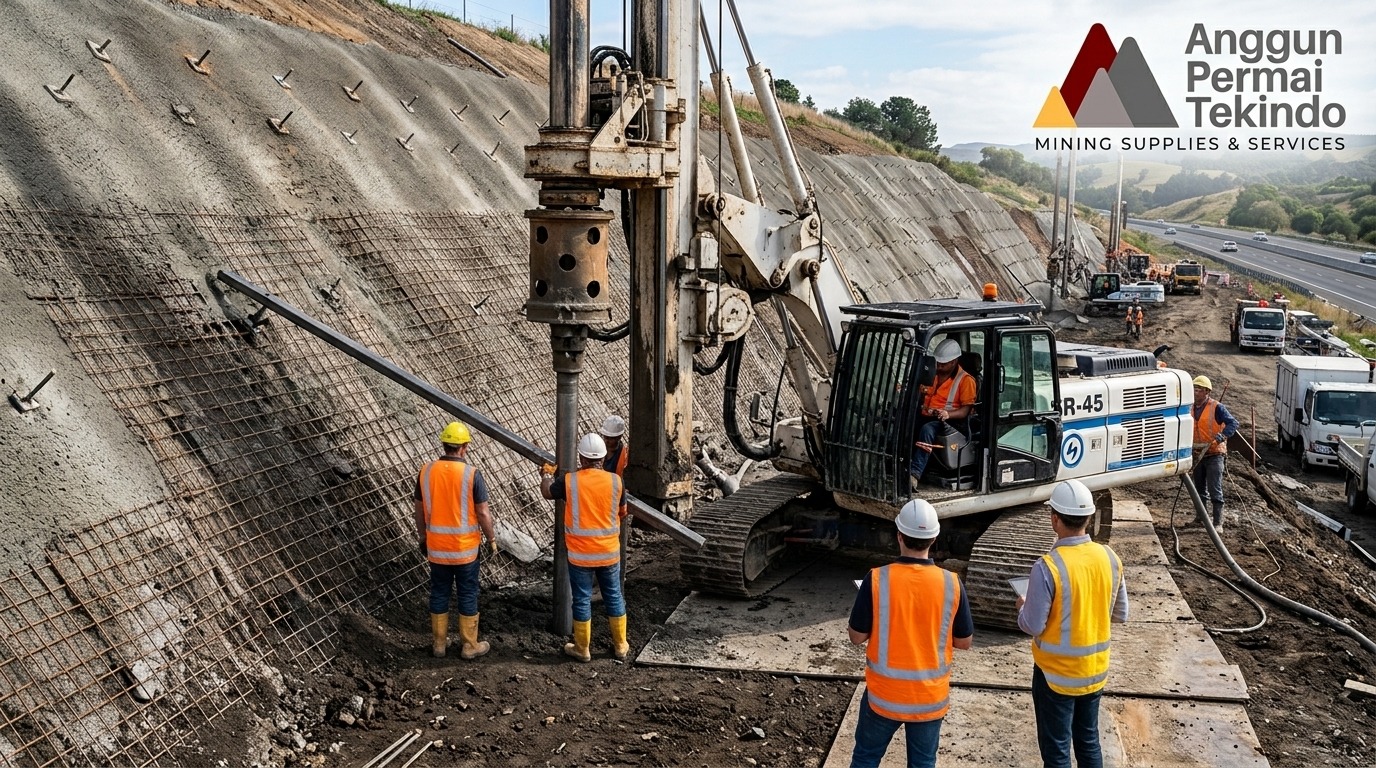
Soil nailing is a slope and excavation reinforcement method that installs closely spaced passive steel bars into the ground, grouts them in place, and covers the surface with shotcrete. The method increases the shear strength and factor of safety of a slope from within, which makes it suitable for excavations, mine benches, and tunnel portals where geotechnical investigation and drainage are adequate.
Key Takeaways
- Principle: soil nailing reinforces the soil mass from within using grouted steel bars, rather than holding the soil back from the outside like a conventional retaining wall.
- Passive behavior: nails only begin to work once the soil starts to move, unlike ground anchors, which are given a prestressing force.
- Main components: nail bars, grout, centralizers, drainage, wire mesh or fiber, shotcrete, and bearing plates with locking nuts.
- Construction sequence: top-down: staged excavation, drilling, nail installation, grouting, drainage, shotcrete, testing, and plate installation.
- Success factors: an accurate geotechnical investigation, drainage designed from the outset, controlled grout and shotcrete quality, and pull-out testing in the field.
- Limitations: less suitable for loose cohesionless sand, soft clay, or saturated soils below the groundwater table without special treatment.
- References: international geotechnical practice (for example FHWA GEC No. 7) and the Indonesian National Standard (SNI) 8460:2017 on geotechnical design requirements.
Introduction
Landslides are among the most costly and dangerous risks in excavation and mining projects. A single event can halt production, damage haul roads and infrastructure, and, most importantly, endanger workers. For this reason, choosing a slope reinforcement method is not merely a question of cost. It is a technical decision that determines whether operations can continue.
Soil nailing is among the methods most often considered for steep excavations because it is flexible, relatively light in equipment requirements, and proven internationally. However, "relatively simple in the field" does not mean "easy to design." The method is highly sensitive to soil conditions, water, and the quality of execution.
This guide is written for contractors, geotechnical engineers, mine planners, and procurement teams. It covers working principles, components, construction stages, design parameters, quality control, comparisons with other methods, and practical implementation tips. At the end, we also describe the services and materials from APTEKINDO that are relevant to each stage of the work.
What Is Soil Nailing?
Soil nailing is an in-situ soil reinforcement technique that installs closely spaced steel bars (nails) into the soil mass, fills the drill holes with grout, and then covers the slope face with shotcrete. As a result, soil that was originally weak works together with the steel bars as a single composite mass that is better able to resist shear forces.
It should be noted that grouting is not an optional extra. Grout bonds the nails to the surrounding soil and at the same time protects the steel from corrosion. Without grout, the steel bars would not have sufficient bond to transfer tensile forces.
How Does Soil Nailing Work?
Imagine a potential slip surface inside a slope. When the soil begins to move along that surface, the nails that cross it are pulled in tension. This tensile force then resists the movement, adds normal force, and increases the shear resistance along the slip surface. Because the nails are closely spaced, the entire reinforced soil mass behaves as a single unit that is far more stable than unreinforced soil.
"Soil nailing is not a wall holding back the slope from the outside. It turns the slope itself into a structure."
Components of a Soil Nailing System
| Component |
Function |
Field notes |
| Nail bar (threaded deformed bar) |
Primary tensile element |
High-strength steel; diameter typically 19–32 mm |
| Cement grout |
Bonds the nail to the soil and protects against corrosion |
Choose non-shrink grout so it does not shrink and maintains bond |
| Centralizer |
Keeps the nail centered in the drill hole |
Ensures an even grout cover |
| Drainage system |
Reduces pore water pressure |
Weep holes, horizontal drains, geocomposite |
| Wire mesh or fiber |
Reinforces the shotcrete layer |
Synthetic fiber can speed up the work |
| Shotcrete (facing) |
Protects the surface and retains shallow soil between nails |
Typical thickness 75–150 mm |
| Bearing plate and locking nut |
Transfers load from the facing to the nail |
Nail ends require corrosion protection |
Soil Nailing vs. Ground Anchors vs. Retaining Walls
| Aspect |
Soil nailing |
Ground anchor |
Concrete retaining wall / sheet pile |
| How it works |
Passive, active once the soil moves |
Active, given a prestressing force |
Holds the load from the outside |
| Spacing and quantity |
Close and numerous |
Wider and fewer |
Continuous structure |
| Reinforcement length |
Relatively short (approximately 0.6–1.0 times the slope height) |
Longer, extending into the stable zone |
Depends on structural design |
| Best suited for |
Staged excavations and relatively uniform soil |
Heavy loads, tall walls, rock conditions |
Ample space and heavy loads |
| Cost per point |
Relatively lower |
Relatively higher |
Generally the highest for tall slopes |
In practice, particularly on complex rock slopes, soil nailing and ground anchors are often combined.
When Soil Nailing Works, and When It Doesn't
Generally suitable:
- Stiff to hard fine-grained soils or dense granular soils with apparent cohesion.
- Weathered rock.
- Staged excavations with limited working space.
- Open-pit mine benches, haul road cut slopes, and tunnel portal walls.
Requires caution or alternative methods:
- Loose sand or gravel without cohesion, because drill holes can easily collapse.
- Soft clay or saturated soil below the groundwater table.
- Soil with large boulders that make drilling difficult.
- Highly corrosive soil when used as a permanent structure without adequate corrosion protection.
Construction Stages for Soil Nailing in the Field
Construction proceeds in stages from top to bottom. The height of each excavation stage is limited so that the temporary slope remains stable before it is reinforced.
- Excavation and slope trimming to the designed geometry, in limited lifts.
- Marking drill points for nails, horizontal drains, and weep holes according to the design pattern.
- Drilling at the specified diameter and inclination, typically about 10–20° from horizontal.
- Nail installation complete with centralizers.
- Grouting until the hole is fully filled and the bar is evenly encased.
- Drainage installation: weep holes, horizontal drains, and geocomposite.
- Wire mesh installation or use of fiber.
- Shotcrete facing as a protective and surface-retaining layer.
- Pull-out testing to verify pull-out capacity against the design.
- Installation of bearing plates and nuts, with corrosion protection at the nail ends.
Repeat this cycle at each excavation stage until the final elevation is reached.
Commonly Used Preliminary Design Parameters
The following table shows typical ranges used in practice as a preliminary reference, in line with international guidelines such as FHWA GEC No. 7. Actual values must be determined through design calculations based on local geotechnical investigation results.
| Parameter |
Typical range |
Notes |
| Nail length |
0.6–1.0 × slope height |
Adjusted to geometry and soil type |
| Nail spacing (V × H) |
1.25–2.0 m (often 1.5 × 1.5 m) |
The weaker the soil, the closer the spacing |
| Drill hole diameter |
100–200 mm |
Depends on drilling and grouting method |
| Nail inclination |
10–20° from horizontal |
Supports grout filling |
| Steel diameter |
19–32 mm |
High-strength threaded steel |
| Shotcrete compressive strength (f′c) |
20–30 MPa |
Facing thickness 75–150 mm |
| Global slope factor of safety, permanent slopes |
Generally ≥ 1.5 (static) and ≥ 1.1 (seismic) |
Refer to geotechnical practice and SNI 8460:2017; adjust to risk class |
| Pull-out factor of safety |
Approximately 2.0 |
Verified through pull-out testing |
FHWA GEC No. 7 (2015) requires checking several failure modes, namely global stability, nail pull-out, steel yielding, and facing capacity, under both static and seismic conditions. This means that meeting the global factor of safety alone is not sufficient.
The Often-Overlooked Role of Drainage
Water is the most common trigger of landslides. Rising pore water pressure reduces effective stress and the shear strength of soil. For this reason, the drainage system should not be treated as an add-on at the end. Design it from the outset: weep holes to penetrate the shotcrete facing, horizontal drains to lower the water level behind the slope, and geocomposite behind the shotcrete to convey seepage water.
Quality Control in the Field
| Aspect |
What is checked |
Reason |
| Drilling |
Diameter, depth, and inclination of holes |
Determines the effective bond length |
| Grout |
Water-cement ratio, flowability, and compressive strength of test specimens |
Determines nail-soil bond and corrosion protection |
| Grout filling |
Hole fully filled without voids |
Voids reduce pull-out capacity |
| Centralizers |
Nail position centered in the hole |
Ensures an even grout cover |
| Shotcrete |
Thickness, compressive strength, and surface quality |
A weak facing can fail first |
| Drainage |
Function of weep holes and horizontal drains |
Prevents excessive pore water pressure |
| Pull-out test |
Pull-out capacity against the design |
Verifies design assumptions |
| Monitoring |
Movement, cracking, and water level |
Early detection of slope behavior |
Testing programs generally include verification tests on trial nails and proof tests on a portion of production nails. The number of tests and test procedures follow the project specifications and the design guidelines used.
Advantages and Disadvantages of Soil Nailing
Advantages
- Generally more economical and faster than massive reinforced concrete walls or sheet piles under many slope conditions.
- Flexible enough to follow irregular slope shapes.
- Relatively light equipment, suitable for limited working spaces.
- Relatively little disruption to traffic or nearby operations.
- Can be combined with ground anchors, geosynthetics, or fiber shotcrete.
Disadvantages
- Less suitable for loose non-cohesive soil or soft saturated soil below the groundwater table.
- Highly dependent on geotechnical investigation; incorrect soil assumptions carry a fatal risk.
- Grout and shotcrete quality are decisive, so quality control must be strict.
- Permanent in nature and difficult to dismantle once installed.
- Vulnerable to long-term corrosion if steel protection is not designed correctly.
Application Examples in Mining and Excavation Projects
Illustration: an open-pit mine bench 12 meters high experiences seepage and tension cracks at the crest during the rainy season. The geotechnical team selects soil nailing with nail lengths of 8–10 meters at 1.5 × 1.5 m spacing, non-shrink grout, fiber shotcrete about 100 mm thick, and horizontal drains. The stability analysis shows the factor of safety rising above 1.5 without a lengthy production shutdown.
Relevant APTEKINDO track record in slope stabilization and protection projects, based on information on its official website:
- West Wanagon slope protection in the Grasberg mining area, in a challenging highland environment.
- An artificial slope stabilization system for PT Agincourt Resources using shotcrete reinforced with biaxial geogrid to control erosion and potential instability on a steeper slope design.
- Geotechnical ground anchor (micropile) work for the foundation of a processing plant (mill), and rock anchors for the vertical mill expansion.
Common Mistakes to Avoid
- Insufficient geotechnical investigation, leaving soil parameters as mere assumptions.
- Excessive excavation height per stage, causing the temporary slope to collapse before the nails are installed.
- Treating drainage as an add-on, rather than an integral part of the design.
- Uncontrolled grout: water ratio too high, shrinkage, or voids left behind.
- Uneven shotcrete application, particularly in thickness and density around nail plates.
- Skipping pull-out testing or failing to follow up on results that deviate from the design.
- Neglecting corrosion protection on permanent structures.
- Not monitoring the slope after construction is completed.
Practical Tips and Recommendations for Contractors and Engineers
- Start with a complete investigation: core drilling, SPT or CPT tests, and groundwater level measurements.
- Limit the excavation height per stage and work from top to bottom.
- Use quality non-shrink grout to maintain nail-soil bond and corrosion protection.
- Design drainage from the outset and check its function on a regular basis.
- Carry out pull-out tests on sample nails to confirm actual capacity.
- Consider fiber shotcrete as an alternative or complement to wire mesh to speed up the work.
- Install monitoring instruments where the consequences of failure are high.
- Engage experienced ground support and geotechnical service providers so that design and execution are aligned.
Relevant APTEKINDO Services and Materials
PT Anggun Permai Tekindo (APTEKINDO) is a supplier of mining materials and services focused on concrete admixtures, shotcrete, grouting, and injection systems, and is an authorized distributor of SIKA Mining Solutions. Through its subsidiary, PT Aptekindo Mitra Solusitama (AMS), APTEKINDO also provides ground support services, geotechnical work, civil engineering, and geosynthetic solutions.
Services
| Service |
Relevance to soil nailing |
| Soil Nailing |
Slope reinforcement with grouted nails and shotcrete |
| Slope Protection |
Integrated protection and stabilization of slope surfaces |
| Injection Grouting |
Injection for reinforcement and water control |
| Artificial Ground Support |
Rock bolting and cable bolting |
| Geotechnical Solutions |
Analysis and execution of geotechnical work |
| Mining Batching Plants |
Concrete supply for mining work requirements |
Materials by Construction Stage
| Stage |
Material (from the Sika and Ground Stabilization lines) |
Function |
| Nail grouting |
Sikagrout 215 NEW and Sikagrout 214-11 |
Non-shrink grout with high bond strength |
| Shotcrete facing |
Sigunit L54-45 AF and Sigunit D430 |
Accelerator to speed up shotcrete setting |
| Concrete fiber |
Sikafiber Force-48 / Force-55 |
Macro synthetic fiber to reduce cracking |
| Concrete quality and workability |
Sika ViscoCrete 305ID and Viscoflow 3660 LR |
Superplasticizer for quality and workability |
| Reinforcement and geosynthetics |
Supporting steel components (nail bar, bearing plate), geocell, and geogrid |
Supports reinforcement and erosion control |
All products can be viewed on APTEKINDO's product pages and the Sika line. Availability and specifications of each product should be confirmed directly with the APTEKINDO team.
Supporting Data and References
- FHWA Geotechnical Engineering Circular No. 7: Soil Nail Walls (2015), an international guideline for the design and construction of soil nail walls.
- SNI 8460:2017 (Indonesian National Standard) on geotechnical design requirements in Indonesia.
- Kepmen ESDM No. 1827 K/30/MEM/2018 (Ministerial Decree of the Ministry of Energy and Mineral Resources) on guidelines for good mining engineering practice (kaidah teknik pertambangan yang baik), including the geotechnical aspects of mine slopes.
- Project geotechnical investigation results and technical material specifications (product data sheets).
FAQ (Frequently Asked Questions)
1. What is soil nailing?
Soil nailing is an in-situ soil reinforcement method that stabilizes slopes by installing closely spaced passive steel bars, filling them with grout, and covering the surface with shotcrete.
2. What is the difference between soil nailing and ground anchors?
Soil nailing is passive, installed closely in large numbers, relatively short, and not prestressed. Ground anchors are active because they are given a prestressing force, are fewer in number, and are usually longer, extending into the stable soil zone.
3. What is the minimum factor of safety for a slope?
For permanent slopes, geotechnical practice and SNI 8460:2017 generally refer to about 1.5 for static conditions and a lower value (for example 1.1) for seismic conditions. The exact value depends on the risk class and project requirements.
4. Is soil nailing suitable for all soil types?
No. The method is most effective in soils with sufficient cohesion or in weathered rock. Loose cohesionless sand or soft saturated soil below the groundwater table requires other methods or a combination of reinforcement measures.
5. Is soil nailing cheaper than a retaining wall?
In many conditions, yes, especially for staged excavations. However, cost comparisons must still be calculated for each project based on soil conditions and slope geometry.
6. Why is grouting so important in soil nailing?
Grout bonds the nail to the soil so that tensile force can be transferred, and at the same time protects the steel from corrosion. Without good grout, the nail will not perform as designed.
7. Why is a pull-out test needed?
A pull-out test verifies that the bond capacity of the nail in the field matches the design assumptions, so differences in soil conditions can be identified before they become a problem.
8. Does APTEKINDO provide soil nailing services?
Yes. According to its official website, APTEKINDO provides soil nailing, slope protection, injection grouting, and ground support services, as well as materials such as grout, shotcrete accelerators, and fibers from the Sika line. Contact the APTEKINDO team for the latest scope and availability.
Conclusion
Soil nailing is an efficient and proven slope reinforcement solution when applied to suitable soil conditions. The method strengthens the slope from within using grouted steel bars covered with shotcrete, with drainage determining long-term stability.
Its success rests on three things: an accurate geotechnical investigation, the right choice of grout and shotcrete materials, and execution by an experienced team under strict quality control. If any one of these is weak, the final result is affected.
Discuss Your Slope Stabilization Needs with APTEKINDO
Planning or evaluating slope reinforcement for your project? The APTEKINDO team can help, from discussing requirements and selecting materials (non-shrink grout, shotcrete accelerators, fibers, and reinforcement components) to executing soil nailing, slope protection, and injection grouting.
- Email: [email protected] and [email protected]
- Phone: 021-52920671
- WhatsApp: Contact via WhatsApp
- Address: Graha Surveyor Indonesia, 15th Floor Suite 1503, Jl. Jend. Gatot Subroto Kav. 56, Jakarta Selatan 12950
- More information: APTEKINDO contact page